Address
304 North Cardinal
St. Dorchester Center, MA 02124
Work Hours
Monday to Friday: 7AM - 7PM
Weekend: 10AM - 5PM
Address
304 North Cardinal
St. Dorchester Center, MA 02124
Work Hours
Monday to Friday: 7AM - 7PM
Weekend: 10AM - 5PM
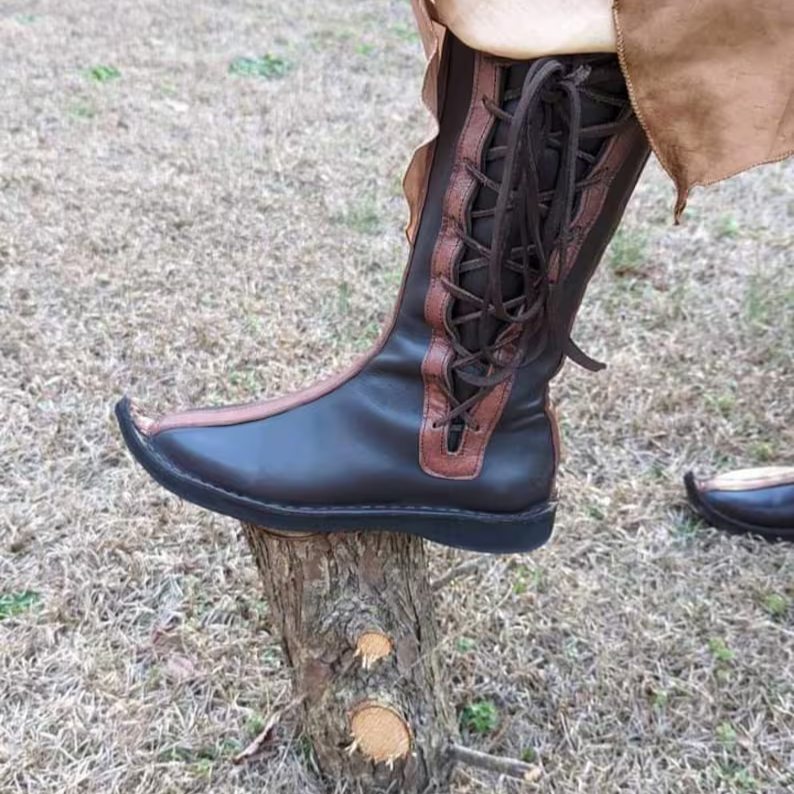
Medieval shoes vs. Viking shoes—it’s one of the most common debates in the historical reenactment and LARP community. And it’s an important one, because getting it wrong can instantly break the authenticity of an otherwise perfect impression.
Are they the same thing? Almost — but not quite. The differences are subtle, historically significant, and practically important when choosing footwear for reenactment, LARP, cosplay, or everyday wear.
In this guide, we break down exactly what separates Viking shoes from medieval shoes, when to wear each, and which is the right choice for your specific needs.
Before we go deep—here is the quick version:
Think of it like this: Viking shoes are a specific type within the wider medieval footwear category.
| Feature | Viking Shoes | Medieval Shoes (broader) |
|---|---|---|
| Time period | 793–1100 AD | 5th–15th century |
| Geographic origin | Scandinavia: Norse settlements | All of Europe |
| Construction | Turnshoe (primary method) | Turnshoe + welted + other methods |
| Sole | Soft leather, hand-stitched | Soft to rigid, varies by period |
| Height | Ankle shoes dominant | Ankle- to knee-high, varies widely |
| Closure | Pull-on or single thong/toggle | Thong, toggle, buckle (later periods) |
| Decoration | Minimal — incised lines only | More varied, including cutwork (late medieval) |
| Best for | Viking Age, early medieval LARP | Any medieval or fantasy setting |
The Viking Age is generally dated from 793 AD (the raid on Lindisfarne) to approximately 1100 AD. During this period, Norse people settled across a vast area — from Iceland and Greenland to Russia and the Mediterranean — and their footwear traveled with them.
Turnshoe construction is the defining feature. The shoe was stitched inside-out, then turned right-side out, creating a smooth interior and a characteristic seam along the sole edge. This technique is confirmed in every major Viking Age shoe find, including the following:
Low ankle height dominated everyday Viking footwear. While higher boots existed for warriors and riders, the standard shoe for men, women, and children was a simple ankle boot—functional, comfortable, and easy to make.
Natural leather in earthy tones—vegetable-tanned leather produces the warm brown tones typical of Viking Age shoes. Some dyed examples exist, but natural brown is the most historically common and safest choice for reenactment.
Minimal decoration—Viking shoes were working footwear. Simple incised line decoration appears on some examples, but elaborate ornamentation was rare.
“Medieval” covers over a thousand years of European history — from the fall of Rome (476 AD) to the end of the 15th century. During that time, footwear changed dramatically.
Here is a simplified timeline of how medieval shoes evolved:
Early Medieval (5th–10th century)
High Medieval (11th–13th century)
Late Medieval (14th–15th century)
If your impression is set anywhere between the 5th and 15th centuries—across any European culture—you are in “medieval” territory. The appropriate shoe style depends on the following:
Viking shoes are period-specific—they belong to the Viking Age and are most appropriate for 8th–11th century impressions.
“Medieval shoes“ is a flexible term—it can refer to early medieval styles almost identical to Viking shoes or to later high and late medieval styles that look very different.
Practical impact: If your LARP setting is “generic fantasy medieval,” either style works. If you are doing strict historical reenactment, the specific century matters enormously.
Viking shoes: Rounded or slightly pointed toe — natural, functional shape
Later medieval shoes: Increasingly pointed toes as you move into the 13th–15th centuries—culminating in the extreme poulaine style of the late medieval period
Practical impact: A rounded-toe shoe is appropriate for the Viking Age through early medieval. Pointed toes signal later medieval periods and higher social status.
Viking shoes: Pull-on (no closure) or a single leather thong—simple and functional
Medieval shoes (later periods): Toggle closures, lace-through designs, and eventually buckles as you move into the 13th century and beyond
Practical impact: If you see metal buckles on “Viking shoes,” they are not historically accurate. Simple thong or pull-on closures are correct for early period impressions.
Viking shoes: Minimal — incised geometric lines on some examples, but plain shoes are the most common and safest historical choice
Medieval shoes (later periods): Increasingly elaborate — cutwork leather patterns, stamped designs, and contrasting leather inlays appear in high and late medieval examples
Practical impact: Plain leather is always correct for Viking impressions. Decorated cutwork shoes are specifically a late medieval (14th–15th century) feature.
Use this simple guide to decide:
For most reenactors and LARP players — especially those just starting to build their kit — we recommend beginning with authentic Viking-style shoes. Here is why:
At moroccancarpetsdecore.com, our handmade Viking shoes are crafted by skilled Moroccan artisans from 100% genuine leather, using hand-stitching techniques consistent with Viking Age turnshoe construction. Every pair is built for real use — not display.
Whether you choose Viking or medieval style, care is the same:
Not exactly. Viking shoes are a specific type of early medieval footwear from the Viking Age (793–1100 AD). “Medieval shoes” is a broader term covering all European footwear from the 5th to 15th centuries—which includes Viking shoes but also many other distinct styles.
Yes—Viking-style turnshoe construction continued into the early 12th century across much of Northern Europe. For impressions set before approximately 1150 AD, Viking-style shoes are generally appropriate.
Viking shoes are ankle-height—the most common everyday Viking Age footwear. Viking boots are taller (mid-calf to knee) and were associated more with warriors, riders, and elite status. For most impressions, shoes are more historically common.
Metal buckles on shoes appear primarily from the 13th century onward in Western Europe. They are not appropriate for Viking Age or early medieval impressions. If you see “Viking shoes” with buckles, they are not historically accurate.
For early medieval and Norse settings: Viking shoes. For later medieval or generic fantasy settings: broader medieval styles give more flexibility. For either, genuine leather hand-stitched construction is far superior to synthetic costume alternatives.
Medieval shoes vs. Viking shoes—the distinction matters more than many people realize, but it does not need to be complicated.
Viking shoes are the historically accurate choice for early medieval and Norse impressions. Broader medieval shoe styles offer more flexibility for later periods and generic fantasy settings. In both cases, genuine leather and hand-stitched construction are non-negotiable if you want footwear that performs at real events.
Ready to make your choice?
👉 Shop handmade Viking Age shoes — authentic construction, genuine leather, all sizes
👉 Shop handmade medieval leather boots—for broader medieval and fantasy impressions

