Address
304 North Cardinal
St. Dorchester Center, MA 02124
Work Hours
Monday to Friday: 7AM - 7PM
Weekend: 10AM - 5PM
Address
304 North Cardinal
St. Dorchester Center, MA 02124
Work Hours
Monday to Friday: 7AM - 7PM
Weekend: 10AM - 5PM
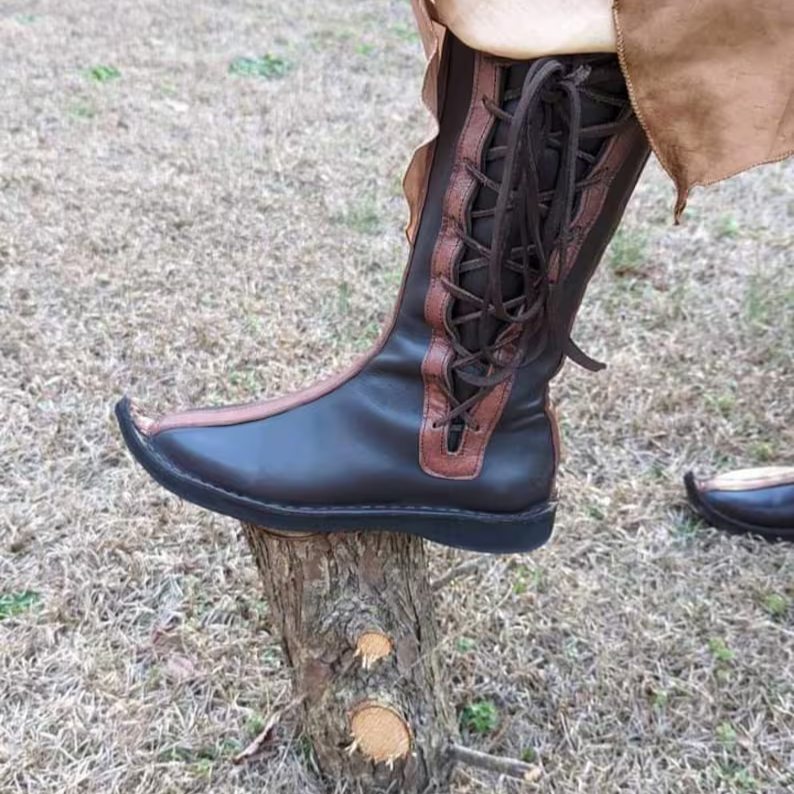
What shoes did Vikings wear? It’s one of the most searched questions in the historical reenactment and LARP communities—and for good reason. Get the footwear wrong, and it undermines everything else about your impression.
The good news: Viking Age shoes are actually well-documented. Hundreds of leather examples have survived in archaeological sites across Northern Europe, giving us a detailed picture of exactly what Norse people put on their feet.
In this guide, we answer the question directly — and then show you the best authentic Viking Age shoes available in 2025 for LARP, reenactment, cosplay, and everyday wear.
Viking footwear was simple, functional, and surprisingly well-made. Here is what the archaeological evidence tells us:
Every confirmed Viking Age shoe found by archaeologists is made from natural leather — specifically vegetable-tanned leather, the same ancient tanning process still practiced in Moroccan tanneries today. There were no synthetic materials, no rubber soles, no fabric uppers. Leather was the universal material for Viking footwear across all social classes.
The defining construction technique of Viking Age shoes is called turnshoe construction:
This technique is documented in finds from York, Dublin, Hedeby, and Bergen — consistently across the entire Viking world.
Contrary to popular imagination, most Vikings did not wear tall boots with elaborate lacing. The most common Viking Age footwear was:
Viking footwear evolved slightly across different times and regions. Here is a quick overview:
If you want to identify a genuinely authentic Viking Age shoe, look for these specific characteristics:
✅ Natural leather upper — single piece or minimal pieces, no synthetic material ✅ Turnshoe construction — smooth interior, seam visible on exterior sole edge ✅ Low ankle height — for most everyday impressions ✅ Soft leather sole — thick but flexible, hand-stitched to the upper ✅ Simple or no closure — pull-on, or single thong/toggle ✅ No metal buckles — buckles were not typical on common Viking footwear ✅ No rubber or platform soles — entirely anachronistic
Now that you know what authentic Viking shoes looked like historically, here is what to look for when buying for LARP or reenactment in 2025:
LARP has specific demands that go beyond historical accuracy alone:
At moroccancarpetsdecore.com, our Viking Age shoes are handcrafted by skilled Moroccan artisans using the same leather traditions that have defined quality footwear for over a thousand years.
Here is why reenactors and LARP players across Europe and North America choose our shoes:
100% Genuine Natural Leather No shortcuts. Every pair is made from real leather—thick enough for outdoor use and supple enough to mold naturally to your foot within a few wears.
Hand-Stitched Construction Each seam is stitched by hand using heavy waxed thread — the same fundamental technique used in Viking Age turnshoe construction. No glue, no staples, no machine shortcuts.
Multi-Layer Leather Sole Built to handle everything from festival grounds to forest terrain. The sole can be repaired by any cobbler when it eventually wears out—unlike glued synthetic alternatives.
All-Day Comfort The leather breaks in naturally over the first 3–5 wears and molds to the exact shape of your foot. Long-term, these become the most comfortable shoes you own.
Historically Appropriate Design Clean lines, a simple silhouette, and natural leather colors are exactly what the archaeological evidence supports for authentic Viking Age footwear.
Getting the right size matters for all-day comfort at events. Here are our recommendations:
| Situation | Sizing Advice |
|---|---|
| Wearing thin socks | Order your true size |
| Wearing wool/thick socks | Order half a size up |
| Between two sizes | Always go up |
| Wide feet | Contact us for custom widths. |
| Children’s sizes | Contact us for custom orders. |
We offer sizes 5 to 16 US/CA for both men and women. Custom sizing is available on request — email us at support@moroccancarpetsdecore.com.
| Viking Shoes | Viking Boots | |
|---|---|---|
| Historical accuracy | Most common everyday style | More elite / warrior impression |
| Best terrain | Indoor, soft ground, summer | Outdoor, rough terrain, cold weather |
| Comfort in heat | Excellent | Can be warm |
| Ankle support | Moderate | Strong |
| Visual impact | Authentic, understated | Commanding presence |
| Price | Lower | Higher |
Our recommendation for beginners: Start with Viking shoes—they cover the most historical impressions, are lighter and cooler, and are easier to style with different outfits. Add boots later for battle or outdoor winter events.
Historical evidence suggests Viking women wore the same basic turnshoe style as men—low-ankle shoes in natural leather. There is no strong archaeological evidence for fundamentally different male vs. female footwear styles in the Viking Age.
Yes, but boots were less common than ankle shoes for everyday wear. Higher footwear appears more frequently in warrior and elite contexts and in colder northern regions. For most reenactment impressions, ankle shoes are more historically accurate.
Natural leather colors dominated—brown in various shades was most common, as vegetable-tanned leather produces warm brown tones naturally. Black leather existed but was less common. Some dyed examples have been found, but natural brown is the safest choice for authenticity.
Genuine leather Viking shoes are extremely comfortable once broken in. The leather molds to your foot within a few wears, creating a custom fit that synthetic alternatives can never match. Wear wool socks and break them in before your first major event.
Brush off dry mud with a stiff brush, then wipe with a slightly damp cloth. Allow to air dry completely away from direct heat, then apply leather conditioner before storing. Never put leather shoes near a radiator or in direct sunlight to dry.
Yes, with waterproofing treatment applied beforehand. Natural beeswax applied 24 hours before a wet outdoor event provides good protection. Avoid submerging the shoes in standing water.
What shoes did Vikings wear? Simple, handmade leather ankle shoes—constructed using the turnshoe method, made from vegetable-tanned natural leather, and built to last through hard daily use.
The best Viking Age shoes for LARP in 2025 follow exactly the same principles: genuine leather, hand-stitched construction, and simple authentic design. Anything less is a costume, not a reenactment piece.
If you’re ready to step into footwear that is historically accurate, genuinely handmade, and built to handle real events — we have exactly what you need.
👉 Shop authentic handmade Viking Age shoes — all sizes available, worldwide shipping in 7–14 days.

