Address
304 North Cardinal
St. Dorchester Center, MA 02124
Work Hours
Monday to Friday: 7AM - 7PM
Weekend: 10AM - 5PM
Address
304 North Cardinal
St. Dorchester Center, MA 02124
Work Hours
Monday to Friday: 7AM - 7PM
Weekend: 10AM - 5PM
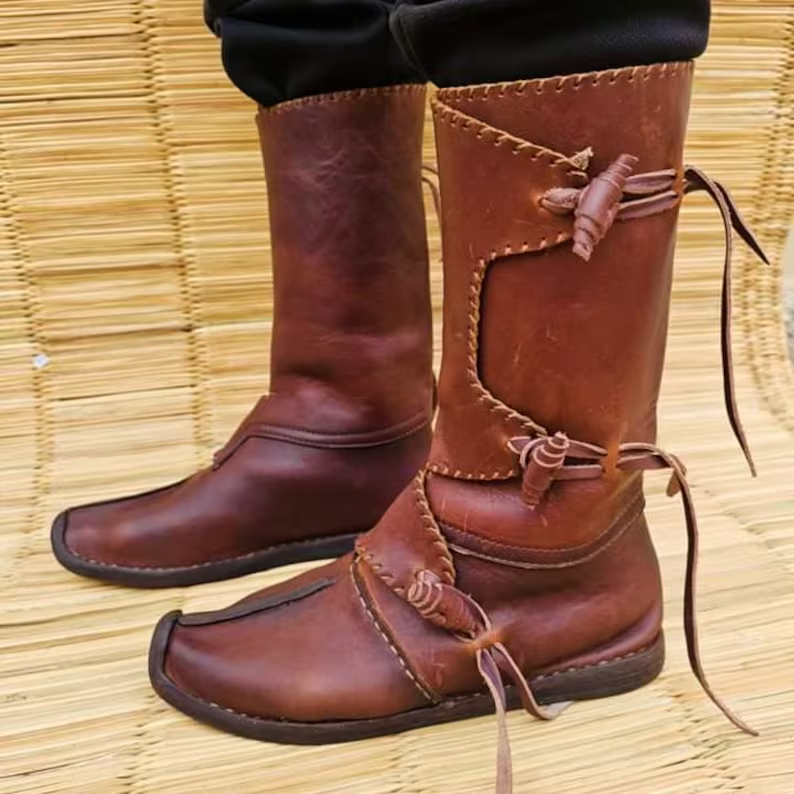
Choosing the best Viking shoes for reenactment and historical events is essential for anyone serious about historical accuracy. While clothing and weapons often get the most attention, footwear is one of the most visible and regulated elements in reenactment environments.
Authentic Viking shoes are not only about appearance. They affect comfort, movement, credibility, and acceptance at events. In this guide, you will learn how to choose the right Viking shoes, which styles are historically accurate, and why handmade footwear consistently outperforms mass-produced alternatives.
Most reenactment groups and historical festivals require period-accurate footwear. Modern shoes instantly break immersion and may even lead to disqualification from events.
According to reconstructions displayed by the
<a href=”https://www.jorvikvikingcentre.co.uk/learn/the-vikings/” target=”_blank” rel=”noopener”>Jorvik Viking Centre</a>,
Viking footwear was designed for daily use, travel, and outdoor conditions.
Archaeological finds from Scandinavia show that Vikings primarily wore handmade leather turn shoes.
Research published by the
<a href=”https://en.natmus.dk/historical-knowledge/denmark/prehistoric-period-until-1050-ad/the-viking-age/” target=”_blank” rel=”noopener”>National Museum of Denmark</a>
confirms that Viking shoes were crafted using simple tools and natural materials.
Turn shoes are constructed inside-out and then turned, following original Viking techniques.
Why they are ideal:
Perfect for summer events and medieval markets.
Best for:
Designed for colder climates and uneven terrain.
Recommended for:
Artifacts preserved by the
<a href=”https://www.britishmuseum.org/collection” target=”_blank” rel=”noopener”>British Museum</a>
demonstrate the durability of early medieval leather footwear.
Conclusion: Handmade Viking shoes are the superior choice for reenactment.
When selecting Viking shoes, consider:
Choosing the right footwear prevents fatigue and improves your overall experience.
Countries like Germany, Denmark, and Sweden have strong reenactment and LARP communities. Museums such as the
<a href=”https://www.historiska.se/exhibitions/the-viking-world/” target=”_blank” rel=”noopener”>Swedish History Museum</a>
continue to promote Viking heritage, increasing demand for authentic equipment.
European buyers strongly value:
Although handmade Viking shoes may cost more, they offer:
For reenactors, footwear is an essential long-term investment.
Yes. High-quality leather adapts to the foot over time.
Handmade Viking shoes are accepted by most reenactment organizations.
Low-cut models can be worn casually, but they are best suited for historical use.
Looking for authentic handmade Viking shoes suitable for reenactment and historical events?

